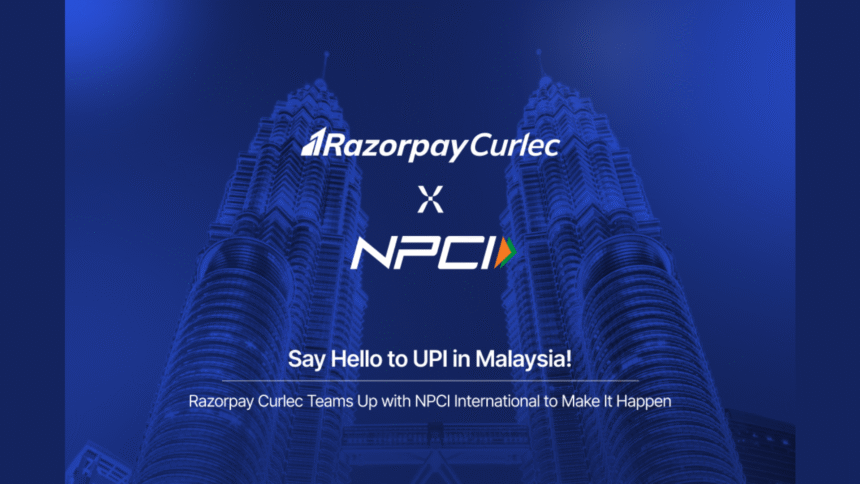
In a major leap towards the globalization of India’s digital payment ecosystem, leading fintech Razorpay today announced the extension of Unified Payments Interface (UPI) payments to Malaysia through its Malaysian subsidiary, Curlec by Razorpay, in partnership with NPCI International Payments Limited. For the first time, this move enables Indian travelers to make hassle-free payments in Malaysia with their UPI apps, with settlement directly in Malaysian Ringgit (RM).
This development, therefore, becomes the first operationalization of Indian UPI services in Malaysia, which attracts over one million Indian tourists every year. With this integration, Indian visitors will no longer have to depend on international credit cards or carry excessive foreign currency. They can now scan QR codes at participating Malaysian merchants and complete transactions instantly using UPI apps like PhonePe, Paytm, or Google Pay.
A Milestone for Cross-Border Fintech Collaboration
This partnership between Razorpay, Curlec, and NPCI International was announced at the Global Fintech Fest 2025. It represents a growing trend of cross-border payment collaborations designed to make digital transactions more inclusive, efficient, and cost-effective.
For Razorpay, this move is part of a broad global vision of exporting the country’s world-class fintech innovations and payment infrastructure. The company entered Southeast Asia with the acquisition of Malaysia-based recurring payments startup Curlec in 2022. Since then, Curlec has been building bridges between local payment ecosystems and global financial networks, and this latest initiative brings those efforts to fruition.
“Our goal has always been to simplify payments not just in India but across borders,” said Harshil Mathur, CEO and co-founder of Razorpay. “With UPI now live in Malaysia, we are making everyday payments effortless for millions of Indian travellers and supporting Malaysian merchants with a new stream of digital customers.”
What the Partnership Means
This new UPI payment option will benefit not only Indian tourists but also Malaysian merchants: for travellers, it eliminates the friction of international payments — no more card conversion fees or withdrawal abroad. For merchants, it opens up a large customer base of visitors from the nation who prefer UPI for its convenience and speed.
The transactions will be processed via the Curlec’s payment infrastructure and settled in local currency, ensuring compliance with Malaysian financial regulations. This design allows for real-time payments without the complexities of international card systems.
Anubhav Sharma, Head of Partnerships at NPCI International, amplified the broader implications: “This isn’t a technology integration; it’s about creating a seamless cross-border payment experience that enhances trade, travel, and financial inclusion. India’s UPI is becoming a benchmark for instant payments globally.”
Boost for Tourism and the ASEAN Digital Economy
Malaysia has always been among the top destinations for Indian travelers. According to Malaysia’s Tourism Board, Indian visitors spent more than RM 6 billion in 2024 alone. By allowing UPI to be used, it is expected that foreign tourist expenditure will increase, adding convenience in retail, hospitality, and transportation sectors.
Tourism and trade analysts see this as a win-win partnership: for India, it is a strategic export of its fintech ecosystem, while for Malaysia, it is a step into deeper digital integration with one of Asia’s largest consumer markets.
Moreover, the initiative is in line with the interoperable cross-border payment agenda envisioned by ASEAN, linking real-time payment systems of member countries by as early as 2026. The cooperation of India with Malaysia may provide a model for linkages with Thailand, Singapore, and Indonesia to accelerate the pace of digital payment connectivity within the region.
Increasing the Fintech Footprint of India
This move positions Razorpay’s latest foray as one that presents India as a budding fintech exporter rather than an innovator confined to the local space. With UPI already being integrated in countries like France, the UAE, and Sri Lanka, the Malaysian launch pinpoints India’s rising influence in global payment infrastructure.
This development also points to a wider trend in the fintech world: a move toward “payment diplomacy” in which digital payment systems become instruments of economic cooperation and international presence. The deal also reflects India’s successful strategy of deploying homegrown technology in building international partnerships.
Challenges and Opportunities Ahead
But while the move has been largely hailed, experts warn that merchant adoption and user awareness will be pivotal to its success. Local businesses need to integrate UPI acceptance into their checkout systems, and travelers must be made aware of where and how they can use it.
Yet, the potential is huge in the long run. This might lead to more fintech startups from India eyeing global expansion and, in turn, encourage more countries toward accepting such cross-border propositions. It further opens the doors for integrations of various kinds in the days to come: digital remittances, P2P transfers, and trade settlements on real-time payment rails.
Conclusion The expansion of Razorpay’s UPI payments into Malaysia extends beyond mere technological milestones; it symbolizes India’s fintech maturity and increasing global reach. By facilitating seamless, real-time transactions across borders, this partnership ushers in a new era where the gap between convenience and innovation is bridged for consumers and businesses alike. This cooperation sets a strong precedent for what digital payment systems can do to further improve international commerce, tourism, and financial inclusion in a cashless and borderless world economy. For India, it reinforces one simple yet powerful message: the future of fintech is global, and leading this charge is UPI.