To extend access to startup innovation beyond typical tech hubs, Google for Startups, in collaboration with edtech and upskilling platform Scaler, introduced a new programme titled “Startup School: Prompt to Prototype.” This initiative will help early-stage Indian founders learn how to build functional prototypes and AI-driven MVPs- Minimum Viable Products-quickly, without requiring technical backgrounds. This program is a reflection of the current evolution in the Indian entrepreneurial ecosystem, with AI-assisted development and low/no-code solutions gradually lowering entry barriers for new founders.
The two-week program is designed to take participants from an idea to a workable prototype, enabling them to validate their concepts more quickly and accelerate toward product-market fit. Topics will include ideation for startups, AI-driven design, MVP, fundamentals of pitching, customer discovery, and business planning. Ultimately, the initiative will enable founders to build smarter, faster, and cheaper by leveraging AI as a collaborative force in innovation.
This initiative assumes significance in a market that is seeing an unprecedented surge in first-time and solo-founders. Many of these aspiring entrepreneurs come with domain expertise, such as in finance, retail, supply chain, and consumer goods, but lack the necessary coding or engineering background to convert their ideas into a technological product. Positioning AI as creative partner and technical accelerator rather than just a tool, the “Prompt to Prototype” program addresses this gap precisely.
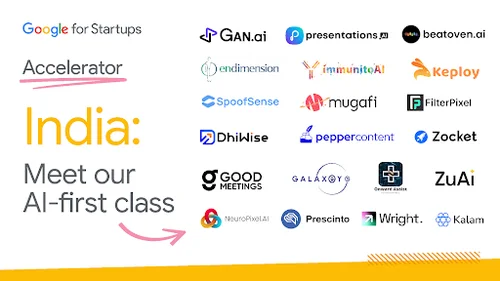
As per Google for Startups, the aim is to support the larger vision of democratizing entrepreneurship in India. The organization has supported numerous Indian startups so far, with its mentorship, funding access, networking opportunities, and workshops. This new programme will more explicitly focus on hands-on product building, making it very practical and outcome-driven.
Scaler provides the best-in-class computer science and technology upskilling programs. It brings experience in product development, tech workshops, and structured learning frameworks to this program. The founders will not only be mentored by instructors but will also be exposed to real-world startup case studies, prototype-building walkthroughs, and environments of peer collaboration. This partnership will merge the strengths of industry-driven learning with access to a global startup ecosystem.
The highlight of the program is that it focuses on AI prototyping tools. Participants will be guided on how they can use modern AI systems to:
UI/UX Screens from Text Prompts
Convert product ideas into structured workflows
Draft the technical requirement documents.
Create demo versions of web and app interfaces.
Simulate user journeys and feedback loops
This also plays into the growing trend of founders increasingly expected to understand the basics of how to build products themselves, even if engineers scale those products later on. The program also encourages founders to build lean, reducing dependence on large early engineering teams that has long been a challenge for idea-stage startups.
The launch of “Startup School: Prompt to Prototype” is relevant in a broad economic context, too. The country has set ambitious targets for itself on becoming a global leader both in the digital services and product innovation realm. Given the role of startups in creating jobs, generating exports, and bringing up new digital infrastructure, enabling more founders to participate in the economy is crucial. AI, in this case, becomes an agent of inclusion. It democratizes entry into the startup ecosystem by letting people with strong ideas but possibly limited technical skill still compete effectively.
According to industry experts, this kind of initiative can reshape the pipeline of startups in India, particularly in Tier-II and Tier-III cities where access to quality engineering resources is limited. As entrepreneurial aspirations gain pace across smaller towns, support systems which integrate mentorship, AI-driven development, and ecosystem access are expected to play a defining role in the success rates of startups.
Over the next few weeks, Google for Startups and Scaler will publish highlights, founder case studies, and prototype showcases emerging from the program. If successful, the program may be scaled to multiple cohorts and could even branch into specialized verticals such as fintech, edtech, consumer tech, healthcare, and SaaS. The message is clear with “Prompt to Prototype”: you no longer need to be a coder to be a tech founder. What you do need is clarity of problem, customer insight, and the willingness to learn and iterate—and the tools to build are increasingly within reach for everyone.