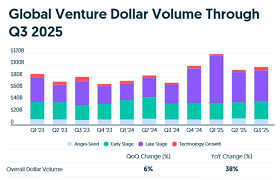
Following a phase of doubt and constricted capital flow, worldwide venture finance is demonstrating robust signals of revival in 2025. As per figures from various investment monitors, venture capital (VC) funding climbed almost 38% year-on-year during Q3 2025 at an estimated US$97 billion, representing one of the most positive quarters since the financing slowdown of 2022–2023. This recovery indicates fresh investor confidence — specifically in AI, deep tech, clean energy, and enterprise automation, areas that are defining the next generation of global innovation.
AI and Deep Tech Capture Investment Flows
Artificial Intelligence remains at the forefront, welcoming billions of new capital as startups create the next frontier in generative AI, autonomous systems, and applied machine learning. More than 45% of venture deals worldwide in Q3 2025 were AI-related, ranging from building basic models to applied use cases in healthcare, finance, and the creative industry.
Top AI funding rounds, according to Crunchbase data, were:
Anthropic, which raised US$2 billion from a combination of institutional investors and tech players to build its enterprise AI infrastructure.
Mistral AI in Europe, which raised US$600 million to grow its open-weight large language models.
Perplexity AI, which is rapidly growing search and assistant platform, closed a US$300 million round at a valuation of US$4 billion.
This investment boom in AI follows a spreading conviction that reasoning and generative AI will be the foundation of virtually every digital business model over the next decade.
Revived Interest in Clean Energy and Climate Tech
Aside from AI, sustainable energy and climate tech startups have regained investor interest. With governments around the world encouraging net-zero ambitions and new energy transition policies, VCs are going all-in on battery storage innovation, hydrogen, carbon capture, and renewable materials.
Startups like Twelve, Climeworks, and Northvolt have made enormous rounds to ramp up production and commercialize clean tech solutions. Interestingly, climate-tech investment grew 52% quarter-on-quarter, becoming the fastest-growing category in international VC.
Experts opine that investors are beginning to favor “impact-plus-return” models — enterprises that can ensure profitability alongside quantifiable sustainability gains.
Regional Dynamics: The U.S. Leads, Asia Accelerates
The US continues to lead venture activity, with almost 48% of all global funding in Q3 2025. Silicon Valley, New York, and Austin are the hubs of startup action, particularly in AI, biotech, and fintech.
Asia, specifically India, Singapore, and Japan, is however experiencing a stepped-up pace of venture flows, led by government incentives in the region, adult tech ecosystems, and increasing investor demand for scaleable digital solutions.
India experienced a 26% increase in venture inflows year on year, led by enterprise SaaS and manufacturing technology startups.
Singapore remains the regional capital for cross-border venture transactions, supporting growing activity in fintech and Web3 domains.
Japan, historically conservative in venture investing, experienced a rebound of corporate VC investment, particularly in robotics and semiconductor technologies.
Europe, although lagging behind in total volume of deals, has shown robust funding pace in AI and green energy — sectors that have been heavily backed by the European Union’s Horizon funding programme.
Late-Stage Deals Recover Momentum
Yet another good indication of recovery is the return of late-stage and growth-stage funding, which had fallen dramatically over the past two years. Late-stage funding comprised 57% of overall VC dollars in Q3 2025, with investors once again supporting firms closer to IPO eligibility or scaled-up profitability.
The most prominent late-stage transactions were Stripe, SpaceX, and Databricks raising more than US$5 billion in fresh capital collectively. Experts explain this comeback as both a sign of investor confidence and a buildup for a new round of IPOs in 2026 as businesses that postponed listings amidst uncertainty in the markets are now set to go public.
The Return of Strategic Corporate Investors
Corporate venture capital (CVC) has also come back as a force to be reckoned with. Industry titans Google, Microsoft, Amazon, Samsung, and Shell Ventures have collectively made more than 500 venture rounds so far this year. Their investment is becoming more strategic — to acquire technological competencies and gain early access to innovations that would supplement their core business.
Investor Sentiment: From “Cautious Optimism” to “Selective Aggression”
Though the funding rebound is reassuring, investors are taking a cautious approach. Unlike the free-spending years of 2020–2021, when capital was available virtually without restriction, today’s venture market is rewarding startups with high-barrier-to-entry paths to profitability, hard-to-ship IP, and real-world use cases. The days of “growth at all costs” have given way to a more realistic emphasis on unit economics and scalability.
Consequently, startup valuations are now more realistic, and due diligence processes are deeper than ever before. Venture capitalists are referring to this phase as “selective aggression” — putting money down quickly, but only when highly convinced.
The Outlook for 2026
If things go the way they have been going, there are forecasts that venture funding across the world could surpass US$400 billion by the end of 2025, marking an end to the post-pandemic funding winter. The growth in the next phase is expected to be fueled by convergence — where artificial intelligence, clean energy, healthcare, and manufacturing converge to address global issues.
For founders, this increase in funding represents both opportunity and burden. Investors want to support revolutionary concepts but anticipate higher business acumen. For the global startup ecosystem, 2025 can already be hailed as the dawn of a new, more sustainable venture cycle — one where innovation and impact co-exist.