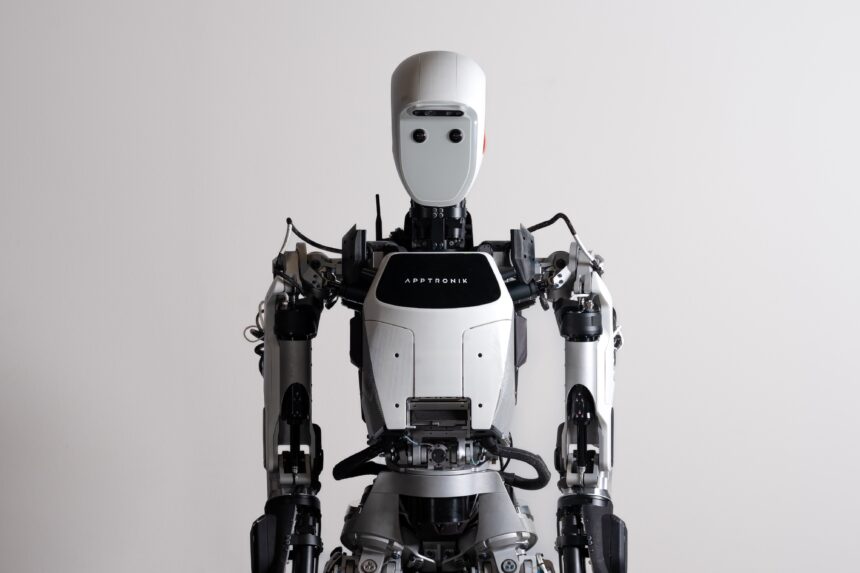
Apptronik, one of the most ambitious players in the fast-moving universe of humanoid robotics, has announced a $5 billion valuation after closing a major round of fresh funding. Based in Texas, this robotics innovator is best known for its humanoid robot, Apollo; it now finds itself positioned as one of the strongest global competitors in the race to build commercially viable humanoid robots that can work with humans across various industries.
The new funding is a milestone not only for Apptronik but also for the wider robotics sector. In recent years, companies worldwide have poured billions into artificial general intelligence, robot learning, and autonomous systems, while human-shaped robots have become one of the most promising yet capital-intensive frontiers. Apptronik’s emergence signals investor conviction that humanoids are moving closer to real-world deployment beyond labs and prototypes into actual commercial use.
From Research Lab Spin-Off to Global Contender
Apptronik was founded out of the Human Centered Robotics Lab at the University of Texas at Austin, where its core engineering team was working on advanced robotic systems. Its flagship humanoid robot, Apollo, attracted global attention for its balanced mix of power, safety, and general-purpose capability. Unlike earlier generations of humanoids, Apollo was designed from day one to be mass-produced, affordable, and capable of performing meaningful labor in logistics, warehousing, light manufacturing, and service tasks.
The company has positioned itself since its founding as a “pragmatic” robotics firm-focused less on flashy demos and more on building a robot that companies can actually deploy reliably, safely, and in volume. That approach has resonated extremely widely with investors, with Apptronik able to secure substantial funding even in the midst of economic uncertainty.
Funding Surge Signals Industry Confidence
The latest funding round, which values the company at $5 billion, reflects a strong surge of interest by investors in humanoid robotics. Around the world, leading robotics and AI firms are seeing a wave of capital investment as businesses seek ways to alleviate labor shortages, automate repetitive physical tasks, and create safer, more efficient industrial operations.
Also contributing to Apptronik’s success is strategic positioning. While many competitors focus their messaging around AI-first robotics or advanced locomotion, Apptronik focuses on real-world readiness, modular design, and human-like safety features. It’s made the company a top choice for enterprises looking for robots that can fit into existing workflows seamlessly.
The new capital will enable the company to accelerate scaling efforts, such as increasing manufacturing capacity, enhancing its robot learning systems, and higher volumes of production. Investors look at Apptronik as a potential global leader in the humanoid robotics category-one that can rival or even outshine companies in the US, Japan, Korea, and China currently working on similar technologies.
Competing in a Crowded Global Landscape
Competition is continuously growing within the humanoid robot market globally, with key players being Tesla’s Optimus, Figure AI, Agility Robotics, and Xiaomi of China. Each firm has developed different approaches to designing, training, and deploying robots.
Apptronik stands out due to three major advantages:
Human-centered engineering: focus on safety, balance, and interaction design.
Industrial applicability: the focus must be on tasks required today by businesses, rather than some visions of things to come.
Scalability: The hardware will be built with mass production in mind rather than bespoke, high-cost prototypes.
It’s these strengths that have helped Apptronik carve out an identity in the humanoid robotics race and position itself as a company capable of delivering practical robots well before many of its competitors.
Transforming Labor With General-Purpose Robots
The promise of humanoid robots lies in their potential to perform tasks that are too dangerous, repetitive, or resource-intensive for human workers. With global labor shortages affecting industries from logistics to manufacturing, companies are increasingly turning to robotics as a long-term solution.
General tasks that Apptronik’s Apollo is engineered to perform include:
Lifting and moving packages
stocking shelves
operating equipment
assist in assembly lines
performing repetitive warehouse operations
By designing the robot to mimic human form and movement, Apptronik avoids the need for costly redesigns of factories and warehouses: robots can operate in spaces built for people.
A Glimpse into the Future of Work Now at a $5 billion valuation, Apptronik isn’t just building robots; it’s creating a future for collaboration between humans and robots. As the company scales, its humanoid systems may become as common in workplaces as industrial arms and autonomous vehicles are today. New funding will accelerate deployment timelines, enhance robot autonomy, and further push Apptronik’s technology toward everyday commercial reality. It could be that the humanoid robotics revolution remains in its earliest stages-but the rise of Apptronik demonstrates investors are convinced that humans and robots will be operating side by side throughout major industries in the future.