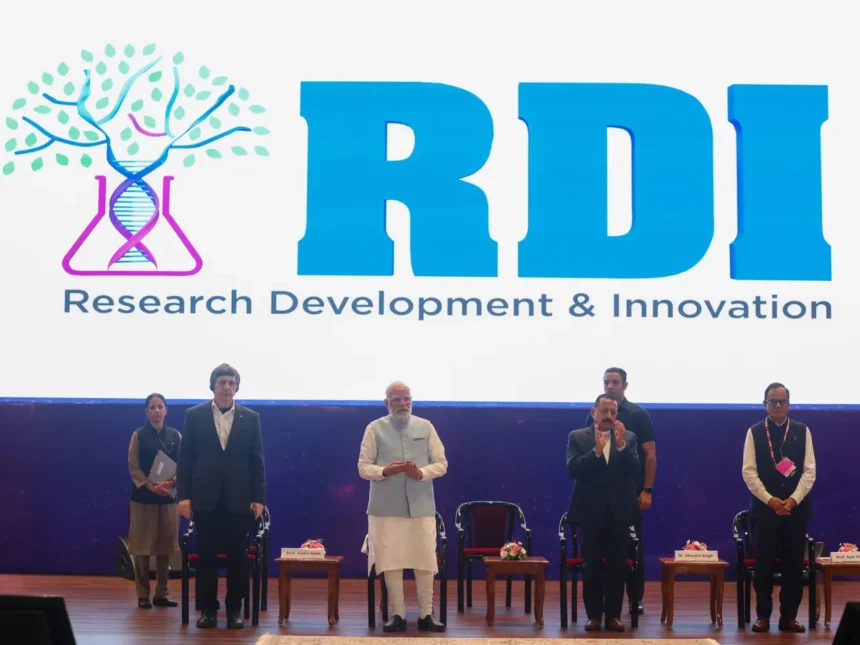
In a move that promises to reshape India’s technological landscape forever, Prime Minister Narendra Modi on Monday unveiled a staggering Rs 1 lakh crore Research, Development, and Innovation (RDI) Fund, aimed at supercharging private sector-led research and development across the country. Announced during the inaugural session of the first-ever Emerging Science, Technology, and Innovation Conclave (ESTIC 2025) at Bharat Mandapam in New Delhi, the announcement has ignited excitement among entrepreneurs, startups, and industry leaders alike.
The RDI Fund is designed to be a game-changer, addressing a long-standing challenge in India’s innovation ecosystem: the lack of high-risk, high-reward funding for breakthrough technologies. Anchored by the Department of Science and Technology (DST), the fund will operate through a two-tier structure. At its core is a Special Purpose Fund housed within the Anusandhan National Research Foundation (ANRF), which will serve as the custodian of the Rs 1 lakh crore corpus.
What makes this fund particularly unique is its innovative approach to disbursing capital. Rather than investing directly in startups or companies, the fund will channel its resources through professional fund managers, including Alternative Investment Funds (AIFs), Development Finance Institutions (DFIs), and Non-Banking Finance Companies (NBFCs). These second-level managers will then recommend projects for funding, with oversight from independent investment committees comprising experts from financial, business, and technical domains. This layered approach ensures that money reaches projects with the highest potential for transformative impact, while minimizing risks associated with high-stakes R&D.
Addressing the audience at ESTIC 2025, Prime Minister Modi described the RDI Fund as a historic milestone for India’s innovation journey. “For the first time, capital is being made available for high-risk and high-impact projects,” he said, emphasizing the government’s commitment to promoting private sector-led research and positioning India as a global hub for technology-driven innovation.
India’s R&D story has already been impressive. Over the past decade, R&D expenditure has doubled, and the number of registered patents has surged seventeen-fold. The country now boasts the world’s third-largest startup ecosystem, with over 6,000 deeptech startups working in frontier areas such as clean energy, advanced materials, semiconductors, and biotechnology. The bio-economy alone has exploded from $10 billion in 2014 to over $140 billion today. The RDI Fund, experts say, could be the push needed to take these numbers to unprecedented heights.
The private sector is abuzz with anticipation. Entrepreneurs and industrial leaders view the fund as a potential catalyst for a wave of innovation that could rival global tech hubs. “This is a once-in-a-generation opportunity for India’s private sector,” said a senior industry executive. “With this kind of financial backing, startups working on cutting-edge technology will have the resources to scale rapidly and compete on the global stage.”
The fund is expected to impact multiple sectors. Clean energy startups could receive critical backing to develop next-generation solutions for carbon reduction. Advanced materials and semiconductor companies could gain the capital needed to make India self-reliant in critical technologies. And biotechnology and life sciences ventures could accelerate breakthroughs in health, agriculture, and environmental sustainability. Analysts also foresee an uptick in collaborations between Indian startups, academia, and global technology players, further strengthening India’s position as a hub for frontier innovation.
The RDI Fund also addresses one of the biggest bottlenecks in India’s private sector R&D: access to patient capital. High-risk research often requires long gestation periods and offers uncertain returns, which historically deterred private investors. By providing a Rs 1 lakh crore corpus specifically aimed at such projects, the government is signaling a paradigm shift—encouraging risk-taking and long-term thinking in a sector that has historically struggled to attract large-scale private funding.
The layered fund management approach also ensures accountability and strategic allocation. Professional fund managers and independent committees will evaluate proposals on financial, technological, and commercial merits. This will help weed out underperforming projects and focus resources on initiatives with transformative potential. The goal is to create an ecosystem where private capital, scientific talent, and strategic oversight converge to accelerate innovation at a scale never seen before in India.
Prime Minister Modi highlighted the broader significance of the fund, linking it to India’s ambition to become a global innovation leader. “This is a transformative moment for India,” he said. “By enabling private sector R&D, we are not only fostering technological breakthroughs but also creating high-value jobs, enhancing global competitiveness, and preparing our economy for the industries of the future.”
Experts believe that the RDI Fund could catalyze a wave of disruptive technologies over the next decade. Artificial intelligence, next-generation batteries, advanced manufacturing, biotech, and semiconductor innovation are all likely to see a surge in development activity. The fund may also inspire global investors to partner with Indian startups, opening doors to cross-border collaborations that can accelerate technological adoption.
With the launch of the Rs 1 lakh crore RDI Fund, India is clearly signaling that it is ready to compete on the world stage, not just as a market for technology, but as a hub for invention and innovation. This is a bold move, one that could define the country’s economic trajectory for decades to come. The world will be watching closely as India transforms its private sector R&D ecosystem, creating a pipeline of high-impact technologies that could shape the future of global industries.
In short, the RDI Fund is more than just a financial initiative—it is a declaration that India is ready to bet big on its innovators, take calculated risks, and lead in the next era of technology-driven growth.