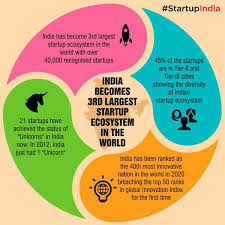
India’s startup ecosystem has scored yet another milestone. The nation now has close to 1.95 lakh (195,000) officially recognized startups, firmly positioning itself as the third biggest startup ecosystem globally after the United States and China, as per the Department for Promotion of Industry and Internal Trade (DPIIT).
This phenomenal growth is indicative of the nation’s changing entrepreneurial ecosystem, in which innovation, digitalization, and government-supported initiatives came together to forge one of the fastest-growing startup ecosystems anywhere in the world.
From Concept to Impact: India’s Startup Story
In 2016, when Startup India was introduced, India boasted fewer than 500 official startups. Fewer than ten years on, that figure has grown almost 400 times over, highlighting how quickly the nation has adopted entrepreneurship.
This DPIIT recognition not only legitimates startups but also gives them access to tax relief, simpler compliances, funding schemes, and international exposure. This has motivated thousands of entrepreneurs—from Tier 1 cities to small towns—to legalise their ventures.
The ecosystem now cuts across more than 660 districts, showing that innovation is no longer confined to urban areas such as Bengaluru, Delhi, or Mumbai. Indore, Jaipur, Kochi, and Coimbatore, smaller cities, are becoming new startup cities based on local talent and regional innovation.
Sectoral Diversity: Beyond Technology
Though technology startups still lead the way, India’s ecosystem has broadened to encompass varied sectors like agritech, fintech, edtech, healthtech, cleantech, and deeptech.
The COVID-19 pandemic served to be a driver of digital adoption, compelling businesses to rethink operations and customers to adopt technology-powered services. Consequently, startups in AI, SaaS, logistics, renewable energy, and D2C brands have experienced explosive growth.
Interestingly, women entrepreneurship startups now constitute over 45% of DPIIT-recognized start-ups, pointing toward changing trends towards inclusivity and diversity in entrepreneurship. Government initiatives like Women Entrepreneurship Platform (WEP) and Startup India Seed Fund Scheme (SISFS) have worked actively to facilitate this shift.
The Role of Policy and Infrastructure
India’s positive government policies have been the driving force behind this growth. Startup India, along with initiatives such as the Fund of Funds for Startups (FFS) and Credit Guarantee Scheme for Startups (CGSS), has facilitated easier access to capital and reduced regulatory hassles.
In addition, India’s successful digital public infrastructure of Aadhaar, UPI, and Open Network for Digital Commerce (ONDC) has given startups the equipment to develop solutions quicker and scale more effectively. These initiatives have built what experts refer to as the “India Stack advantage,” allowing startups to construct trusted, interoperable digital solutions.
India’s Global Startup Standing
Worldwide, India is currently in the third position after the U.S. and China in the total number of recognized startups. India also has more than 110 unicorns, valued at over $350 billion in aggregate. Indian startups are still piquing robust interest from both local and foreign investors even as funding internationally has slowed due to macroeconomic issues.
India is likely to have over 250 unicorns by 2030, buoyed by innovation in areas such as AI, sustainability, and financial inclusion, as per a recent study by Nasscom and Zinnov. Bengaluru, dubbed the Silicon Valley of India, remains the nerve center of startup activity, accounting for close to 40% of total ventures identified.
Challenges and the Road Ahead
Even with the milestone, the ecosystem continues to struggle with issues—particularly funding availability for early-stage startups and market access to global markets. Most founders also stress the need for ease of compliance, stronger intellectual property protection, and international mentorship networks to enable Indian startups to scale globally.
Still, the prognosis is good. The growth in involvement of corporate accelerators, university incubators, and state-sponsored innovation programs has ensured that the ecosystem continues to deepen and improve both in terms of quality and depth.
A Defining Moment for Indian Entrepreneurship
Passing the 1.95 lakh startup milestone is not just symbolic—it reflects increasing confidence, strength, and determination of Indian entrepreneurs. From small-town inventors creating eco-friendly products to high-tech startups creating world-class AI products, India’s startup narrative is one of inclusivity and disruption.
As the country looks to become a $5 trillion economy, startups are set to play a pivotal role in powering growth, jobs, and digitalization.
In the words of a DPIIT official, “India’s startup revolution is not just about numbers—it’s about ideas that are solving real problems, creating jobs, and redefining the country’s economic future.”