

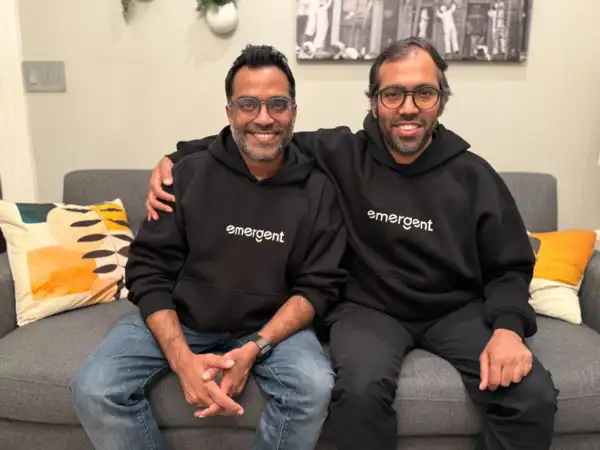
In a major boost to India’s fast-growing AI innovation ecosystem, agentic-coding startup Emergent has raised a strategic investment from Google’s AI Futures Fund, marking one of the most impactful early-stage partnerships in the global AI-developer tools landscape. The investment, announced this week, positions Emergent as one of the fastest-growing companies in the “vibe-coding” or autonomous AI-coding space-a domain that is increasingly reshaping how software is being built, deployed, and scaled.
Emergent was founded in 2025 by brothers Mukund Jha and Madhav Jha. It allows users to develop production-grade, full-stack applications using AI agents instead of manually coding. The users describe their idea in text format and Emergent’s autonomous agent system creates the codebase, then designs the interface, integrates APIs, tests the final product, and gets it ready for deployment. This is something that takes a development team and weeks to accomplish; with Emergent, the same task can be executed within hours or, at most, minutes.
The company’s rapid momentum over the past months seems to have played an important role in attracting Google’s interest. Emergent claims it has surpassed 2.5 million users around the world in just five months since the launch, a remarkable adoption curve even by global AI standards. During that time, it attained an annual recurring revenue run-rate of $25 million, making it one of the fastest-scaling AI tool startups of the year.
The strategic investment for Google aligns with the AI Futures Fund’s charter to invest in early-stage companies either building foundational AI technologies or pioneering new workflows driven by AI. Beyond capital, the partnership also includes access to advanced Google AI models, including next-generation agentic and reasoning models that can significantly enhance Emergent’s product capabilities. The startup also stands to leverage Google’s global cloud infrastructure and technical expertise.
In a statement released after the announcement, the co-founder of Emergent, Mukund Jha, said the partnership fortifies the company’s mission to “democratize software creation.” He noted that millions of entrepreneurs, small business owners, creators, and students face a shortage of technical expertise, and hence, have been unable to turn those ideas into real digital products. “With support from Google, we are accelerating our push toward making app development accessible to every individual globally, regardless of technical background,” he said.
Industry insiders see the investment as part of a broader trend in the global startup and developer ecosystem. As generative AI becomes more powerful, it is able to perform tasks once considered solely within the domain of human developers — including code scaffolding, debugging, architectural planning, and UI/UX design. Emergent’s approach takes this a step further with its introduction of autonomous AI agents that can handle both creative and functional aspects of application development.
But the potential impact goes far beyond that of individual entrepreneurs. Emergent would allow small and medium-sized businesses, which rarely have the resources to invest in good software development, to build internal tools, customer-facing platforms, or automation systems for a fraction of what it normally costs. For large enterprises, agentic AI systems might support rapid prototyping and reduce dependence on extended development cycles.
However, analysts also mention that this new paradigm will also raise several questions about oversight, quality control, and regulation of the software. As such AI-generated applications gain wide acceptance, concerns about data privacy, security vulnerabilities, ownership of proprietary code, and compliance with global software standards will arise. With Google’s support and credibility, Emergent is likely to shore up compliance and security frameworks as it scales.
The startup has previously gained backing from top investors like Lightspeed, Prosus Ventures, Y Combinator, and well-known AI leaders like Jeff Dean and Balaji Srinivasan. Google’s cap table entry adds another layer of validation — and competition — in a space where global giants like OpenAI, Anthropic, and Replit are also creating cutting-edge AI-code generation technologies. In the near future, Emergent is planning to further expand its team in India and the US, scale its research and development units, while introducing more advanced agentic workflows to automate most of the complex app-building tasks. The company is also gearing up for a global rollout with interest growing from Southeast Asia, Europe, and the US startup ecosystem. With this new strategic backing, Emergent is poised as much more than a promising Indian AI startup but as a challenger on the world stage leading into a future where software creation is no longer limited to coders but available to anyone with an idea.


